Quick Answer
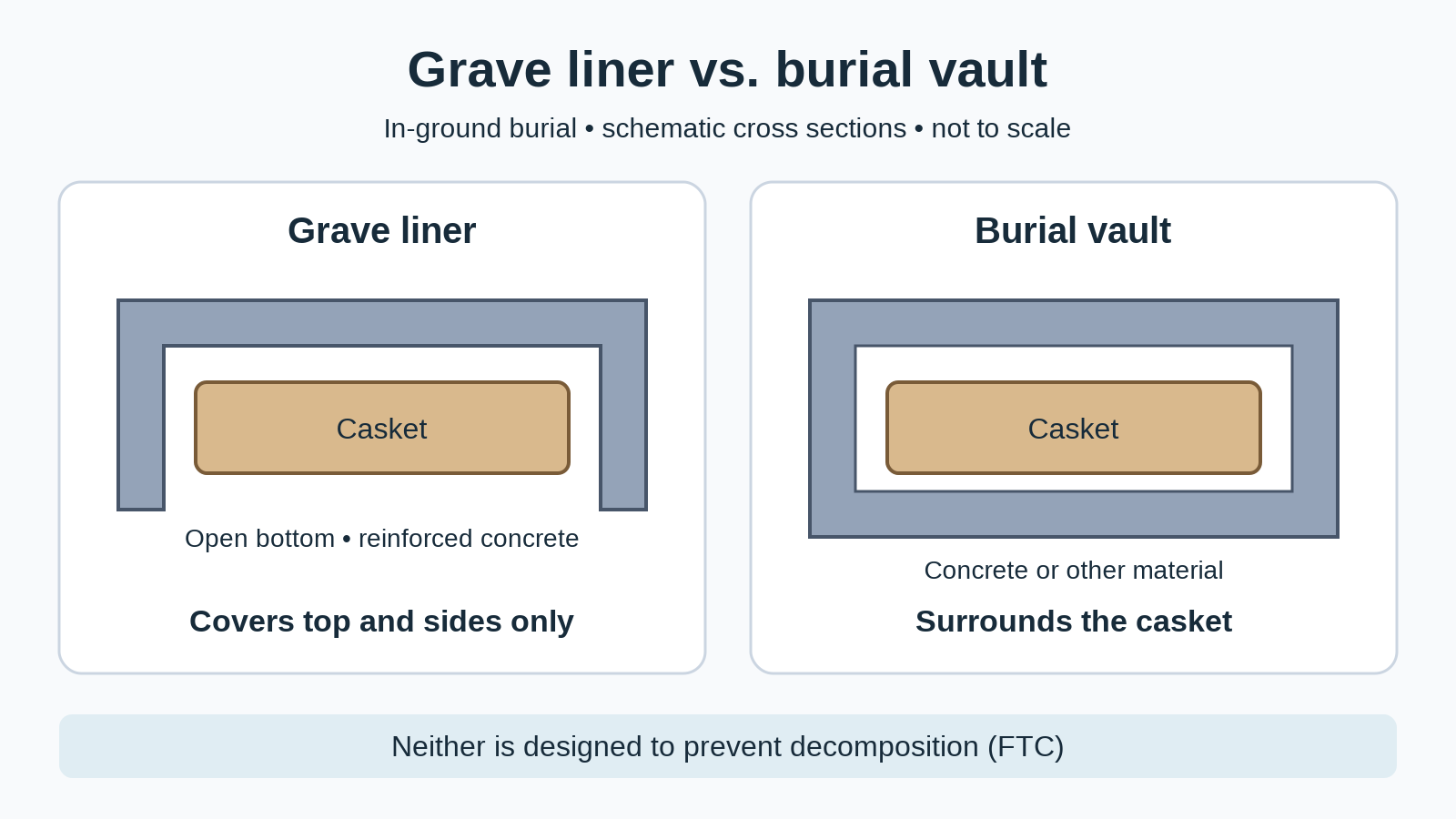
A grave liner covers the top and sides of a casket, with an open bottom. A burial vault surrounds the casket completely. According to the FTC, no state law requires either one, but many cemeteries require an outer burial container; either a liner or a vault satisfies that requirement. Neither is designed to prevent eventual decomposition.
Before agreeing to a vault, ask for the cemetery rule and the price of a basic liner. This is one part of the wider burial cost checklist, so keep the container price separate from other arrangements.
What Is an Outer Burial Container?
An outer burial container goes in the grave around the casket. The FTC uses this term for burial vaults, grave boxes, and grave liners. The container is placed in the ground before burial, and the casket is lowered into it. It is a separate item from the casket itself.
Its purpose is to keep the ground from caving in as the casket deteriorates. The Funeral Consumers Alliance also explains that stable ground makes mowing with heavy equipment easier. That explains why a cemetery may require a container even though state law does not. See FTC: Funeral Costs and Pricing Checklist and Funeral Consumers Alliance: Traditional Burial.
This guide covers in-ground casket burial. For above-ground options, see our mausoleum guide.
Grave Liner vs. Burial Vault: The Differences
The main difference is how much of the casket the container surrounds. A concrete burial vault has a bottom as well as sides and a top; a grave liner covers only the top and sides. The diagram above shows this structural difference, not a promise about preservation.
| Feature | Grave liner | Burial vault |
|---|---|---|
| What it covers | Top and sides; open underneath | Surrounds the casket completely |
| Materials | Reinforced concrete | Concrete or other materials, including steel or fiberglass-type materials |
| Typical purpose | Helps prevent the grave from sinking | Helps prevent the grave from sinking |
| Warranty | Ask for any written terms | May be sold with a warranty of protective strength |
| Meets a cemetery container requirement? | Yes, according to the FTC; confirm cemetery specifications | Yes; confirm cemetery specifications |
| Relative price | Less expensive | More substantial and more expensive |
These distinctions come from the FTC and Funeral Consumers Alliance. A more expensive enclosure is not automatically necessary to meet a cemetery rule. Ask which basic liner meets the requirements before comparing optional vault features.
Is a Burial Vault Required by Law?
The FTC: The FTC Funeral Rule says outer burial containers are not required by state law anywhere in the United States. Many cemeteries do require them to prevent the grave from sinking. A cemetery policy can affect what you must buy for that location, but it should not be presented as a state-law requirement.
If someone says a vault is mandatory, ask: “Is this a cemetery rule, and can I have a copy?” Then ask whether a grave liner meets it. The required disclosure in 16 CFR § 453.3: Misrepresentations says either a grave liner or a burial vault satisfies cemetery container requirements. It also prohibits funeral providers from falsely claiming that a law or a particular cemetery requires a container.
When a funeral home presents a legal or cemetery requirement as compelling a purchase, it must identify and briefly describe that requirement on your written statement of selected goods and services. Ask to see that explanation before paying.
The Funeral Rule does not apply to cemeteries without an on-site funeral home, or to third-party sellers. Ask the cemetery directly for its policy rather than assuming the funeral home’s explanation is the complete answer. Our funeral home guide explains the broader purchasing rights.
What a Vault Can and Cannot Do
A vault supports the grave as the casket deteriorates. It does not stop the natural process that happens to human remains. The FTC states that neither a grave liner nor a burial vault is designed to prevent eventual decomposition.
Some vaults are sold with a warranty of protective strength. Read what that warranty actually covers; the phrase does not establish that the body will be preserved. Ask the seller to explain the written terms without relying on reassuring sales language.
Federal Funeral Rule provisions prohibit funeral providers from claiming long-term or indefinite delay of decomposition, or claiming protection from gravesite substances when that is not true. The FTC also warns against false claims that a vault will keep water, dirt, or debris from entering the casket. Base your comparison on the cemetery’s requirements, the container description, and the written price.
How Much Does a Burial Vault Cost?
The NFDA: 2023 General Price List Study reported a median vault price of $1,695 in 2023. This figure came from funeral-home General Price Lists in a survey of NFDA members. It is a historical midpoint, not a current local quote or a grave liner price.
The FTC describes a liner as less expensive than a vault. Ask for both prices rather than using a vault quote as the minimum you must spend. Compare container type, material, seller, and exactly what each quote includes.
Keep the cemetery bill in view as well. The FTC checklist separates “Grave liner, if required” from “Opening and closing the grave.” Ask whether delivery and placement are included in the container quote and where opening and closing appear. Do not assume a container price includes all work at the gravesite.
For the full budget, use the burial costs guide. Here, the decision is narrower: what container does this cemetery require, and what is the itemized price of a compliant option?
How to Buy One Without Overpaying
Start with the price list. A funeral provider must give you prices and descriptions before showing outer burial containers. If prices are not on its General Price List, ask to see the separate outer burial container list. If cheaper containers are missing from the display, ask about them.
- Confirm the minimum. Get the cemetery rule and ask which basic grave liner complies.
- Compare the same items. Request the model description, material, written warranty if offered, and an itemized total from each seller.
- Check another seller. The FTC says third-party dealers may be less expensive. Compare more than one source before selecting a model.
- Check specifications before ordering. Get the cemetery’s size, shape, and material requirements in writing.
- Choose items separately. The Funeral Rule lets you select the goods and services you want or need instead of accepting an unwanted package.
The California Cemetery and Funeral Bureau: Consumer Guide (2013) specifically says you do not have to buy the outer container from the cemetery, but an outside purchase must meet its size, shape, and material standards. This is California consumer guidance; use it as a prompt to confirm your cemetery’s written specifications before buying elsewhere.
For other policy questions before choosing a location, use our cemetery selection guide.
When You May Not Need to Buy One
Ask natural burial cemeteries or natural burial sections about their container policies. The Funeral Consumers Alliance notes that some religious traditions call for burial directly in the earth without a vault, and some cemeteries set aside areas for that purpose. Confirm the rule for the specific section you are considering.
Our green burial overview, green burial planning guide, and natural burial cemetery directory can help you explore those options. Bring any religious requirements into the conversation before selecting a grave.
For eligible burial in a VA national cemetery, the government provides a burial liner at no cost to the family. Confirm arrangements with the national cemetery before purchasing a container. This benefit does not mean funeral-home goods and services are covered; those remain the family’s expense. See VA: What does burial in a VA national cemetery include?, our veterans burial guide, and the national cemetery directory.
If you are burying an urn, ask the cemetery whether it requires an urn vault or other container. If you are still deciding between arrangements, our cremation vs. burial comparison addresses that broader choice.
Questions to Ask the Cemetery and Funeral Home
Take these questions to both offices so the container quote matches the actual cemetery policy. Keep the answers with your pre-planning records.
- Does this grave or section require an outer burial container? Please give me the written rule.
- Which basic grave liner satisfies the requirement?
- What size, shape, and material specifications must an outside purchase meet?
- May I see the complete container price list before looking at models?
- What lower-priced options are available?
- Does the quote include delivery and placement? Where are opening and closing listed?
- What does any warranty cover, and can I read it before deciding?
- Will the funeral home describe any requirement compelling this purchase on my written statement?
Frequently Asked Questions
What is a vault for burial?
A burial vault is an outer burial container that completely surrounds the casket in the grave. It may be made of concrete or other materials. Its purpose is to help prevent the ground from sinking as the casket deteriorates.
Is it illegal to bury someone without a vault?
The FTC says no state law requires a burial vault or grave liner. A cemetery may have its own container requirement. Ask for that policy in writing and whether a basic liner satisfies it before selecting a container.
Can I choose a grave liner instead of a burial vault?
The FTC says a grave liner satisfies cemetery outer burial container requirements. Get the cemetery’s specifications before ordering, especially if you plan to buy from another seller.
Does a burial vault stop decomposition?
No. Neither a vault nor a liner is designed to prevent eventual decomposition. A warranty of protective strength should not be read as a promise to preserve human remains.
What is the burial vault price benchmark?
NFDA reported a median vault price of $1,695 in its 2023 survey of member funeral-home General Price Lists. That is historical survey data, not a current quote, and it does not establish a liner price.
Do I have to buy the container in a funeral package?
The FTC Funeral Rule allows you to choose individual goods and services rather than accept an unwanted package. Ask for an itemized container price and check the cemetery’s actual requirement.
Does a VA national cemetery provide a liner?
Yes. For eligible burial in a VA national cemetery, the government provides a burial liner at no cost to the family. Confirm the arrangements with that cemetery before making a separate purchase.
Sources
Last checked: October 2026. Definitions and purchasing rights follow the FTC sources below; the price benchmark is from the NFDA 2023 study.
- FTC: Funeral Costs and Pricing Checklist
- FTC: The FTC Funeral Rule
- 16 CFR § 453.3: Misrepresentations
- FTC: Complying with the Funeral Rule
- NFDA: 2023 General Price List Study
- Funeral Consumers Alliance: Traditional Burial
- California Cemetery and Funeral Bureau: Consumer Guide (2013)
- VA: What does burial in a VA national cemetery include?
- National Cemetery Administration: Information for Veterans
Need Help Planning?
Use our funeral planning guide to organize the next steps. Explore the cemetery planning guides or browse types of cemeteries to compare locations and their policies.
Advertisement